Are You Having Trouble Staying Healthy at Work?
Could the very place where you earn your living be the reason for your chronic headaches, persistent cough, or sudden skin rashes? For many Americans, the answer is a resounding “yes.”
According to data from the Bureau of Labor Statistics (BLS) and OSHA, approximately 2.6 million nonfatal workplace injuries and illnesses were reported by private industry employers in the United States in 2023 (the most recent data available).
With OSHA’s increased enforcement of the General Duty Clause and new ANSI/ASHRAE standards for indoor air and heat, employers are now under more scrutiny than ever to ensure their facilities aren’t becoming health hazards.
Whether you’re an HR manager or safety officer protecting your bottom line, a business owner avoiding a six-figure fine, or a worker on the front lines, understanding the modern signs of a “sick building” is essential.
Here’s the updated breakdown of how your workplace might be making you sick and what current OSHA guidelines say about it.
Related: Cleaner Air, Stronger Heart: The Workplace Connection
Related: Improve Workplace Safety & Health, Increase Your Bottom Line
Signs of “Sick Building Syndrome” at Work
“Sick Building Syndrome” (SBS) isn’t just a 90s buzzword; it’s a modern liability. Primary indicators occur when employees experience acute health effects seemingly linked to time spent in a building, yet no specific illness or cause can be identified.
In 2025, OSHA and ASHRAE tightened recommendations for Indoor Air Quality (IAQ). If your team is complaining of “heavy air,” dry mucous membranes, or mental fatigue, it’s time to look at your HVAC filtration and CO2 levels. Current guidance suggests keeping CO2 below 1,000 ppm.
If your ventilation system simply recirculates stale, pathogen-heavy air, you aren’t just risking a cold – you are risking a “General Duty Clause” violation for failing to provide a workspace free from recognized hazards.
Poor Indoor Air-Quality, Chronic Headaches and Fatigue
Chronic headaches are often the “canary in the coal mine” for poor ventilation or chemical off-gassing. However, you must also look at Volatile Organic Compounds (VOCs) found in modern office furniture and industrial cleaning agents.
OSHA’s current focus has expanded to include “Psychosocial Hazards.” If your workplace is poorly lit, excessively noisy, or lacks proper temperature control, the body reacts with a physical stress response.
Chronic fatigue in the workplace is often a combination of poor oxygenation and high cortisol (stress hormone) levels from environmental stressors. If multiple employees are reaching for aspirin by 2:00 PM, your building’s HVAC or lighting system could be the culprit.
How To Know If Your Workplace Mold is Making You Sick
Mold remains one of the most common reasons for occupational health complaints. Signs include persistent sneezing, watery eyes, and skin irritation that clears up over the weekend but returns on Monday morning.
Under 2025 standards, “visible mold” is an automatic red flag for OSHA inspectors. Yet, even bigger dangers often hide behind drywall or in HVAC drip pans.
Employers are now expected to have a Moisture Management Plan. If you ignore a leak for more than 48 hours, you essentially invite mold to colonize, which can lead to long-term respiratory issues and expensive workers’ compensation claims.
Symptoms of Occupational Heat Stress and Poor Ventilation
A major update in 2025 is the OSHA Proposed Federal Heat Standard. It’s a common misconception that heat illness only happens outdoors.
If your warehouse, kitchen, or factory floor hits a heat index of 80°F, you are legally required to provide “suitably cool” water, shade, and rest breaks.
Symptoms of indoor heat stress include:
* Heat Exhaustion: Dizziness, heavy sweating, and nausea.
* Brain Fog: A drop in cognitive function that leads to accidents.
* Heat Rash: Often ignored but a sign that the skin cannot properly cool the body.
If your workplace feels “stuffy” and hot, it isn’t just uncomfortable – it’s a citable offense. In 2025, OSHA fines for “Serious” violations have risen to over $16,500, and if you willfully ignore heat triggers, fines can skyrocket to over $165,000.
See OSHA’s Heat Injury and Illness Prevention in Outdoor and Indoor Work Settings Rulemaking.
Your Rights if Your Workplace is Making You Sick
Workers today enjoy more protections than ever. Under OSHA’s Section 11(c), employees have the right to voice concerns about workplace health hazards without fear of retaliation.
Furthermore, the 2025 update to the PPE Standard mandates that all protective gear—like respirators for poor air quality—must properly fit the individual worker. Ill-fitting gear is no longer an excuse – it’s a violation.
Bottom Line for Employers
The “price” of an unhealthy workplace is no longer just a few sick days. It’s the cost of increased insurance premiums, lost productivity, and aggressive OSHA penalties. To protect your team and your business:
- Monitor Air: Upgrade to MERV-13 filters and check CO2 levels.
- Watch the Thermometer: Implement a Heat Injury and Illness Prevention Plan (HIIPP)once temps hit 80°F.
- Listen to Your Staff: If “everyone has a cold, “it’s probably not a cold—it’s the building.
By taking a proactive approach to occupational health, you ensure your workplace remains a site of productivity, not a source of pathology. Stay clean, stay cool, and stay compliant.
Key Takeaways
These days, a healthy workplace is no longer a luxury. Instead, it’s a baseline requirement for operational success.
The signs that a building is making its occupants sick – persistent headaches, respiratory distress, and heat-related fatigue – are early warning signals that, if ignored, lead to the “Triple Threat” of business failure: skyrocketing workers’ compensation claims, high employee turnover, and devastating OSHA penalties.
As an employer, your best defense is a proactive offense. Transitioning from reactive “duster-and-fan” solutions to sophisticated Indoor Air Quality monitoring and Heat Illness Prevention Plans protects your most valuable asset—your people.
For workers, staying informed about your rights to a safe environment and properly fitting PPE ensures you return home in the same condition you arrived.
By aligning your facility with current 2025 OSHA standards, you aren’t just avoiding a $165,000 fine; you are building a resilient, productive, and truly healthy workforce.
Stay In Compliance With Worksite Medical
In most cases, OSHA requires medical surveillance testing, and at no cost to employees.
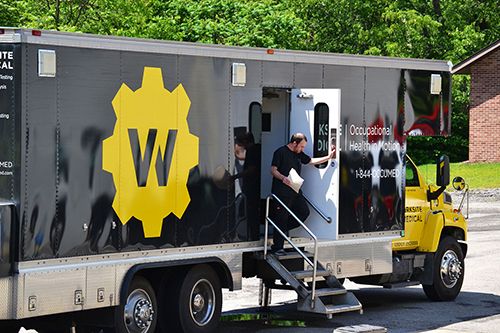
Worksite Medical makes that program easier with mobile medical testing.
We conduct audiometric exams, silica exam physicals, OSHA and HIPAA compliant online respirator medical clearances, on-site respirator fit tests (including N95 masks), pulmonary function tests, heavy metal lab work, and much more, right on your job site.
We also keep accurate, easy-to-access medical records for your convenience. You’ll keep your employees at work, and stay ahead of OSHA and MSHA inspections.
With Worksite Medical, a mobile medical testing unit — we can bring all the resources of a lab to you. Our certified lab technicians can perform both qualitative and quantitative respirator tests to ensure a perfect fit.
Protect your team and your workplace now with Worksite Medical. Not sure what you need? Try our medical testing wizard here.
Give us a call at 1-844-622-8633, or complete the form below to schedule an on-site visit or to get your free quote.
Convenient, Compliant Occupational Medicine. Worksite Medical – Let Us Come to You!
Create a Less Disruptive, More Productive Occupational Health Plan with Worksite Medical!
Are you looking for a way to keep your team safe, while also limiting risk and increasing production? Simplify your medical plan today. We help team leaders like you develop less disruptive, more convenient occupational health plans that comply with complex industry standards, thus creating a healthier, more productive workforce. Take control of your medical testing program, and make sure your business remains OSHA-compliant.