Making Carbon Monoxide Protection a Priority
Carbon monoxide (CO) poisoning is a silent, serious, and preventable hazard in workplaces across the nation. Because this gas is colorless, odorless, and tasteless, hundreds of workers are exposed each year, often with fatal consequences.
In the U.S, hundreds of workers die from carbon monoxide poisoning each year.
Whether you operate a warehouse, a marine terminal, a construction site, or a facility that relies on fuel-burning equipment, understanding and strictly adhering to modern safety standards is crucial for protecting your team.
Here, we’ll outline the essential steps and current OSHA regulatory requirements you must follow to manage the risk of carbon monoxide exposure, ensuring your workplace safety program is compliant and effective.
Let’s break it down.
Related: 8 Key Tips for Protecting Workers from Hazardous Gases
Related: Carbon Monoxide Poisoning Claims Maintenance Worker’s Life
Current OSHA Carbon Monoxide Exposure Limit (PEL)
While the core regulatory limit has remained the same, most experts agree that current best practices demand stricter controls than the minimum legal standard.
The foundational requirement from OSHA is the Permissible Exposure Limit (PEL).
– OSHA PEL: 50 parts per million (ppm), averaged over an 8-hour workday (Time-Weighted Average or TWA).
Crucially, however, regulatory bodies and health organizations recommend more protective limits:
– NIOSH Recommended Exposure Limit (REL): 35 ppm (10-hour TWA). The National Institute for Occupational Safety and Health (NIOSH) also sets a Ceiling Limit of 200 ppm, which must not be exceeded for any 15-minute period.
– ACGIH Threshold Limit Value (TLV): 25 ppm (8-hour TWA).
For employers committed to maximum workplace safety, aligning with the lower, more health-protective limits (like 35 ppm or 25 ppm) is the recommended path to minimizing both short-term and long-term health risks associated with CO exposure.
See OSHA’s Fact Sheet on Carbon Monoxide Poisoning
Key Symptoms of CO Poisoning and Who’s at Risk
Any occupation utilizing fuel-burning equipment in enclosed or partially enclosed spaces remains at risk. This is especially true during colder months when ventilation is reduced to conserve heat.
High-Risk Worker Profiles Include:
- – Welder
- – Garage mechanic
- – Firefighter
- – Carbon-black maker
- – Organic chemical synthesizer
- – Metal oxide reducer
- – Longshore worker
- – Diesel engine operator
- – Forklift operator
- – Marine terminal worker
- – Toll booth or tunnel attendant
- – Police officer
- – Taxi driver
Sources of Carbon Monoxide in the Workplace:
CO is a byproduct of incomplete combustion.
- The most common sources include:
- – Gasoline and propane-powered forklifts and industrial vehicles
- – Portable generators
- – Pressure washers, compressors, and pumps
- – Temporary or faulty heating devices
- – Welding equipment and furnaces
Warning Signs of Overexposure:
Because CO binds to hemoglobin in the blood, starving the body of oxygen, symptoms often mimic the flu.
It is vital for workers and supervisors to recognize them immediately:
- – Headache
- – Dizziness or drowsiness
- – Nausea and vomiting
- – Chest pain or tightness
- – Confusion or weakness
In high concentrations, workers can lose consciousness and suffocate within minutes.
See OSHA’s Standard for Carbon monoxide (1917.24).
How Employers Can Prevent Carbon Monoxide Poisoning in the Workplace
Prevention consists of a multi-layered process involving engineering, administration, and training.
1. Engineering Controls:
– Ventilation: Install or ensure the use of effective local exhaust systems to capture CO at the source, or robust general mechanical ventilation in enclosed areas. Your HVAC system must move contaminated air away from workers.
– Substitution: Where possible, replace gasoline or propane-powered equipment (like forklifts and generators) with electric, battery-powered, or compressed-air alternatives.
– Relocation: Prohibit the use of fuel-burning engines or tools inside buildings or in poorly ventilated areas. If running a generator, place it outdoors and at least 20 feet away from any building openings (doors, windows, air intakes).
2. Administrative Controls and Work Practices:
– Maintenance: Implement a strict, regular maintenance program for all fuel-burning equipment to minimize CO emissions. Check for faulty burners, clogged exhaust systems, and leaks.
– Written Plan: Create a comprehensive, written CO control plan that details hazards, monitoring procedures, maintenance schedules, and emergency response.
– Training: Educate all employees on the sources, symptoms, and control measures for carbon monoxide exposure. Encourage workers to report symptoms or potential ventilation issues immediately.
Workplace CO Monitoring and Detection Required
General-purpose CO detectors are not sufficient for industrial settings.
Monitoring must be continuous, accurate, and tailored to your work environment.
– Personal CO Monitors: Workers operating fuel-powered equipment or those in high-risk zones (e.g., confined spaces) should be equipped with personal, wearable gas monitors that feature loud audible and visual alarms. These monitors provide immediate exposure feedback.
– Fixed Detectors: Install fixed CO monitors in areas where CO hazards exist, such as boiler rooms or vehicle bays, providing continuous, documented air quality testing.
– Critical Warning: Do not use residential-grade detectors. Residential CO alarms (e.g., those meeting UL 2034) are designed for the home and have alarm set points that may be too high or too slow to react to be effective in a rapidly changing or hazardous industrial environment. They could fail to alarm even if the air concentration is above OSHA’s PEL.
Correct Procedure for CO Rescue and Respiratory Protection
Emergency response must be swift and safe. The immediate action is to move the victim to fresh air and call emergency services (911).
Rescuers must follow strict guidelines to avoid becoming victims themselves.
A Critical Note on Respiratory Protection:
NEVER use a chemical cartridge or canister respirator for protection against carbon monoxide. CO is a gas that cannot be filtered or adsorbed by standard chemical cartridges, meaning these respirators offer no protection and can create a false sense of security.
For rescue, entry into an atmosphere with high CO concentrations, or any situation above the PEL where engineering controls fail, workers must use:
– A full-facepiece pressure-demand Self-Contained Breathing Apparatus (SCBA).
– A full-facepiece pressure-demand supplied-air respirator – with an auxiliary self-contained air supply.
Rescue Protocol Summary:
- Move the victim immediately to an open area with fresh air.
- Call 911or your local emergency number.
- Rescuers must be appropriately trained and wear an SCBA before attempting entry or recovery in an unsafe atmosphere.
- Administer 100% oxygen using a tight-fitting mask if the victim is breathing.
- Administer CPR if the victim has stopped breathing.
Key Takeaways
To protect workers, employers must comply with the OSHA PEL of 50 ppm (8-hour TWA), but should implement stricter controls based on the NIOSH REL of 35 ppm (and 200 ppm ceiling), using personal CO monitors and ensuring that chemical cartridge respirators are never used. Rather, workers should make use of Self-Contained Breathing Apparatus (SCBA) for emergencies.
By adopting these controls (focusing on lower exposure limits, mandating proper monitoring technology, and strictly adhering to correct respiratory protection) you can significantly minimize the carbon monoxide poisoning risk and ensure a safe and compliant working environment for your entire team.
Stay In Compliance With Worksite Medical
In most cases, OSHA requires medical surveillance testing, and at no cost to employees.
Worksite Medical makes that program easier with mobile medical testing.
We conduct audiometric exams, silica exam physicals, OSHA and HIPAA compliant online respirator medical clearances, on-site respirator fit tests (including N95 masks), pulmonary function tests, heavy metal lab work, and much more, right on your job site.
We also keep accurate, easy-to-access medical records for your convenience. You’ll keep your employees at work, and stay ahead of OSHA inspections.
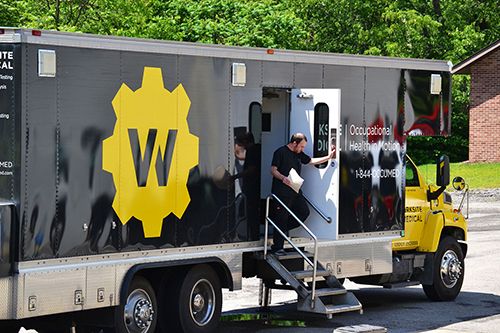
With Worksite Medical, a mobile medical testing unit — we can bring all the resources of a lab to you. Our certified lab technicians can perform both qualitative and quantitative respirator tests to ensure a perfect fit.
You’ll keep your employees at work, and stay ahead of OSHA and MSHA inspections.
Protect your team and your workplace now with Worksite Medical. Not sure what you need? Try our medical testing wizard here.
Give us a call at 1-844-622-8633, or complete the form below to schedule an on-site visit or to get your free quote.
Convenient, Compliant Occupational Medicine. Worksite Medical – Let Us Come to You!
Create a Less Disruptive, More Productive Occupational Health Plan with Worksite Medical!
Are you looking for a way to keep your team safe, while also limiting risk and increasing production? Simplify your medical plan today. We help team leaders like you develop less disruptive, more convenient occupational health plans that comply with complex industry standards, thus creating a healthier, more productive workforce. Take control of your medical testing program, and make sure your team is within OSHA requirements.