New stats from NIOSH on occupational hearing loss
According to a recent report, the prevalence of work-related hearing damage has improved less than 1 percent from 1981 to 2010.
That’s more than thirty years with minimal improvement. Industries are failing to protect the 22 million workers that are exposed to hazardous noise every day.
Furthermore, the estimated workers’ compensation payout from employers with employees who experience hearing loss is around $242 million.
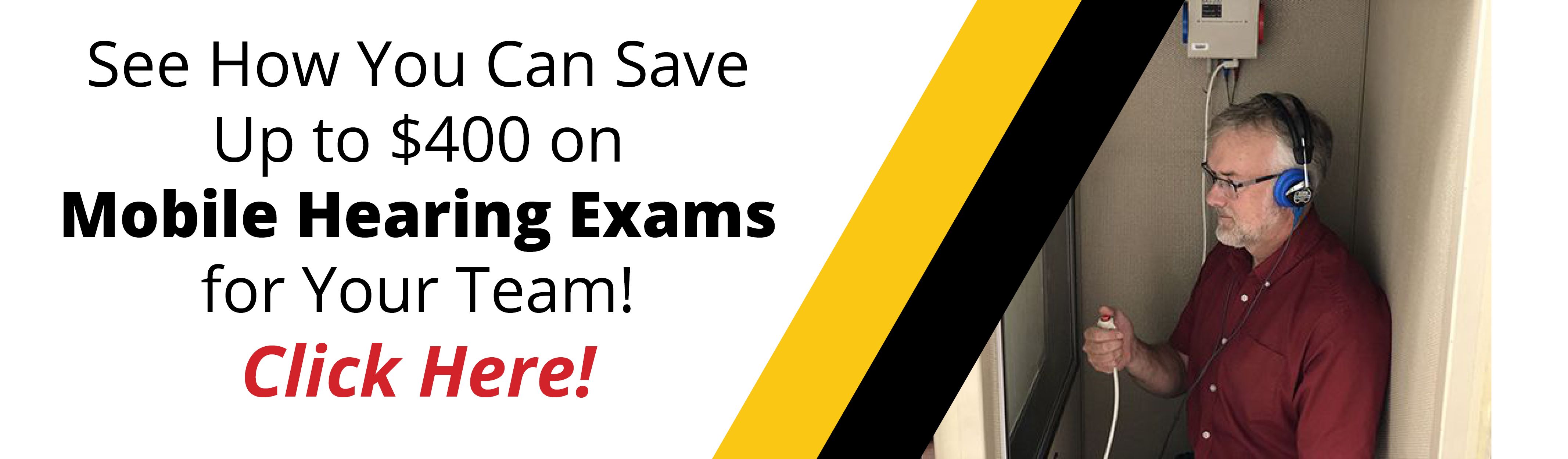
Schedule Now: Mobile Audio Exams
These stats should serve as a wake-up call for employers to take action for the health of their workers — especially in industries most at risk for hearing damage, such as mining, construction, and manufacturing.
In order to protect workers from hearing loss, OSHA created and enforced Regulation 29CFR 1910.95. It states that employees exposed to sound levels at, or above, 85 decibels adjusted (dBA) for an 8-hour time-weight average must be provided with some means to mitigate their exposure to the hazard.
In other words, if an employee endures hazardous noise for a specific period of time, his/her employer must monitor that employee’s hearing, and offer ways to conserve and protect it.
Outlined below is what you need to know about hearing damage risks and how to protect workers in compliance with OSHA standards.
How Does Hearing Loss Occur?
Hearing loss can occur when workers are either exposed to industrial noise, or ototoxic (‘ear poisonous’) chemicals.
Noise-induced hearing loss (NIHL) is the main culprit, accounting for about one-third of occupational health issues, with the most cases occurring in manufacturing. Perhaps one of the reasons why hearing loss is so prevalent is because it is not always detected right away.
The first symptom is usually the inability to hear a high-pitched noise, which the worker may not notice. This can then transform into more serious damage that no surgery or hearing aid can fix.
Long-term exposure isn’t the only way hearing damage occurs; workers can be equally affected by a brief, yet strong exposure to a loud noise, such as a nail gun.
This type of noise, also known as an “impulse,” can even split the eardrum membrane. That’s as painful as it sounds, but the damage (unlike with long-term exposure) is treatable.
The Effects of Hearing Damage
Perhaps the most common effect of hearing damage is Tinnitus.
Most people have experienced the sensation of ringing in their ears — but those suffering from Tinnitus may hear this ringing or booming sound constantly.
NIOSH reports that 8 percent of all workers suffer from Tinnitus, which unfortunately may be the first noticeable sign of damage.
Workers whose hearing is affected by ototoxic chemicals in combination with high noise levels are at the highest risk for hearing damage. Ototoxic exposure can occur during jobs such as painting, radiator repair, weapons firing, boat building, and more.
Loud noise on the worksite can also affect employees mentally, as well as physically.
OSHA notes: “Loud noise can create physical and psychological stress, reduce productivity, interfere with communication and concentration, and contribute to workplace accidents and injuries by making it difficult to hear warning signals.”
According to NIOSH, 19 percent of noise-exposed tested workers have a material impairment.
Hearing loss may not physically hurt, but it can deeply impact the ability to communicate with others, leading to social and psychological distress.
How to Avoid Hearing Damage on Your Worksite
It’s time to change the hearing-loss statistics.
Relying on your employees to speak up about hearing issues is not a solution, and by that time damage has already been done. If your worksite doesn’t already have a medical surveillance program, it’s time to put one in place.
On-site medical testing and surveillance is convenient and proactive.
Audiometric screening can detect any slight hearing issues, and save your employees from further damage. It will also save your company in excessive workers’ compensation claims and OSHA fines.
With a mobile medical company such as Worksite Medical® — the testing comes to you.
On top of audiometric screening, you can have other tests done to make sure you’re OSHA compliant and your workers are healthy.
This includes PPE testing, which can make sure that protective hearing equipment is properly working and meets requirements.
Take a step towards changing the hearing damage stats and schedule an onsite test for your worksite.
If any of your employees are affected by hearing loss, you’ll know right away — and you’ll be ready the next time OSHA visits.