Silica Rule In General Industry & Maritime Might Not See Such Lenience in Enforcement
As you might already know, nearly two years ago OSHA released its final rule on protecting workers throughout the United States from exposure to respirable crystalline silica.
Since, many industry groups argued that several of the provisions, including a significant permissible exposure limit (PEL) reduction, were unnecessary and economically not feasible. However, the U.S. Court of Appeals for the D.C. Circuit rejected all industry challenges last December, thus we now know that, at least for the foreseeable future, the silica rule is here to stay.
(Related Article: Silica Rule Remains Unchanged in Court of Appeals)
Initial enforcement for silica, which began with the construction industry late in 2017, was delayed for three months to allow for additional outreach and training. Then, when enforcement began last September, OSHA offered “good faith” assistance during the first 30 days to employers that were making good efforts to meet the new requirements.
The administration’s goal, after all, was to keep the approximately 2.3 million U.S. workers affected by silica safe from incurable respiratory diseases such as silicosis and COPD.
Many employers opted to use the “wait and see” approach during the appeals process last year. Unfortunately, those who made that decision are beginning to see just how difficult it is to not only find silica testing medical providers, but also to get scheduled in time to comply with the new rule.
One important thing to consider for this round of enforcement, set for June 23, 2018 in General Industry and Maritime, is that OSHA may not be as lenient when it comes to citations and shutdowns given that these companies had over two years to prepare.
What is OSHA’s Definition of “General Industry,” and What Should I Know?
About 295,000 workers across 75,000 general industry and maritime workplaces are exposed to respirable crystalline silica. For general industry, these workers include those who manufacture glass, pottery, ceramic, brick, concrete, asphalt roofing, jewelry, artificial stone, dental, porcelain, or structural clay products.
Also included are those who use industrial sand in operations such as foundry work and hydraulic fracturing. And, in the case of maritime operations, those who use sand for abrasive blasting are also at risk for silica exposure.
So, how much silica dust would it take to meet or exceed OSHA’s PEL of 50 μg/m3, or 840 micrograms, averaged over an 8-hour workday?
Consider this: according to IQPowerTools.com, one standard paver cut releases approximately 9 million micrograms of silica. That means that a single cut would release enough silica dust to meet the PEL for over 29 years worth of shifts.
It’s probably time to make sure those respirators fit, right?
Initially, employers must offer medical surveillance testing to employees exposed above the PEL for more than 30 days per year. However, beginning on June 23, 2020, the rule will become even more strict.
At that point, testing will need to be offered when exposure is at or above the action level — 25 μg/m3, or a mere 420 micrograms — instead of the PEL.
Aside from medical surveillance testing, which includes standard medical and physical examinations, any employees that are exposed above the action level for 30 days or more per year must be offered chest x-rays & lung function tests every three years.
Though, no matter what, the initial required testing must include the following: completion of a Medical History Questionnaire, a Physical Examination, a Chest X-Ray with B-Reader, a Pulmonary Function Test, and a Tuberculosis test.
Furthermore, additional testing is necessary outside of the silica standard when employees are wearing respirators, such as completing an initial respirator medical questionnaire and respirator fit testing.
(Related: Learn More About Mobile OSHA Silica Testing)
Schedule Silica Testing Early!
Over the past year, safety managers from all across the United States have reached out to us to secure silica medical testing. The consensus is that finding companies that offer mobile medical solutions, let alone any full solutions in terms of the new silica rule is quite difficult.
And, spaces fill up quickly because everyone wants to beat OSHA’s compliance deadlines.
If you’re part of our mailing list, then you’ve seen that we were really pushing the idea of scheduling early over the past six months. With less than three weeks left between now and the June 23 deadline, you might be hard-pressed to secure a date.
Once enforcement begins, you’ll be given a set amount of time to comply if/when an OSHA inspector shows up on your job site, and it will be significantly harder to scramble around and get everyone tested in that short time frame, let alone find a medical surveillance company that can quickly insert you into its schedule.
And, with maximum OSHA fines now closing in on $13,000 per serious, other-than-serious, or posting requirements violation, and upwards of $129,000 per willful or repeated violation, your company stands to pay out a hefty chunk of change for being out of compliance.
In order to keep track of their health and safety programs, most of our clients typically pair their silica rule testing with other medical surveillance tests, such as audiometric testing, DOT physicals, or even flu-shot vaccinations.
Because we are able to do everything at one time, it provides an added level of convenience, as well as peace of mind. Whether or not that is the right solution for you, we still entreat you to put your company and your team in the best position to succeed.
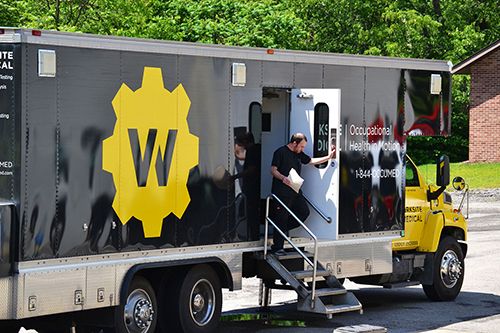
Create a Less Disruptive, More Productive Occupational Health Plan with Worksite Medical!
Are you looking for a way to keep your team safe, while also limiting risk and increasing production? Simplify your medical plan today. We help team leaders like you develop less disruptive, more convenient occupational health plans that comply with complex industry standards, thus creating a healthier, more productive workforce. Take control of your medical testing program, and make sure your team is within NFPA 1582 requirements.