Pneumonic plague is exceptionally rare in the United States. But for employers in healthcare, laboratories, veterinary medicine, wildlife management, and emergency response, the possibility of exposure still warrants a plan.
Updated CDC data show an average of five human plague cases per year in the U.S., with cases concentrated primarily in the rural West, particularly northern New Mexico and Arizona. More than 80% of U.S. cases have historically been bubonic rather than pneumonic. Another CDC analysis of U.S. plague exposures from 1991–2018 identified 10 occupational exposures, including veterinary professionals, wildlife biologists, trappers, and a laboratory worker.
The occupational risk is particularly relevant for workers who handle patients, animals, animal tissues, clinical specimens, or Y. pestis.
On October 2, 2026, a 28-year-old worker at an anti-plague research institute (in Irkutsk, Siberia) died from pneumonia of unknown origin, prompting monitoring of contacts and renewed attention to laboratory biosafety and potential pneumonic plague exposure. And, even more recently, October 16, Madagascar reported several confirmed cases, too.
Here, we’ll explain how employers can prevent exposure, protect workers, and respond quickly to suspected pneumonic plague cases.
Related: Don’t Overlook These Occupational Respiratory Illnesses
Related: Key Benefits of a Workplace Respiratory Protection Program
Pneumonic Plague And How It Spreads At Work
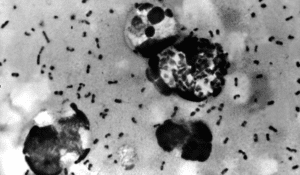
Pneumonic plague is a severe infection caused by Yersinia pestis that affects the lungs.
It can develop when plague bacteria spread to the lungs from another form of plague or when a person inhales infectious respiratory droplets from a person or animal with pneumonic plague.
It is the only form of plague capable of person-to-person transmission.
For workplace prevention, an important distinction is that CDC guidance describes person-to-person transmission as occurring through respiratory droplets rather than fine airborne aerosols. Close, sustained contact (particularly within about 6 feet of an infectious person) is the key concern.
Aerosol-generating laboratory or medical procedures can also create additional exposure risks.
– See CDC’s Guidance for Responding to a Plague Bioterrorism Event.
Symptoms Of Pneumonic Plague
Pneumonic plague can begin suddenly and become serious quickly.
Warning signs include fever, chills, headache, weakness, coughing, chest pain, and shortness of breath. In some cases, individuals may also cough up bloody or watery mucus.
CDC notes that the incubation period following inhalation can be as short as one day, and untreated disease can progress rapidly.
What Should Happen If An Employee Becomes Ill At Work
If an employee develops symptoms consistent with pneumonic plague following a potential exposure, immediate action is essential.
Separate the employee from others, provide a surgical mask if appropriate, and arrange urgent medical evaluation. Employers should also notify their designated occupational health provider and follow established emergency response procedures.
Healthcare facilities should implement standard and droplet precautions while coordinating diagnostic testing and next steps with public health officials.
– See OSHA’s Guidance on Plague Controls.
How Quickly Post-Exposure Prophylaxis Should Begin
Post-exposure prophylaxis (PEP) – preventative antibiotics given based on exposure – is not automatically required for everyone who was in the same building.
CDC recommends considering PEP for people who had close, sustained contact (generally within 6 feet) with a pneumonic-plague patient without adequate PPE, as well as certain laboratory exposures or direct contact with infected animals or tissues.
Recommended PEP duration is seven days.
OSHA Regulations And PPE Requirements For Pneumonic Plague
There is no single OSHA standard specifically requiring an N95 respirator for every workplace dealing with pneumonic plague. Employers should instead use a hazard assessment and applicable OSHA requirements to control recognized occupational hazards.
– For healthcare and other settings, relevant OSHA protections can include the PPE requirements in 29 CFR 1910 Subpart I and, where applicable, the Bloodborne Pathogens Standard. OSHA also notes that the General Duty Clause can apply to recognized infectious-disease hazards.
– PPE should match the task and exposure risk. CDC recommends standard and droplet precautions when caring for suspected or confirmed pneumonic plague patients.
– Healthcare personnel performing procedures likely to produce splashes should use appropriate mask and eye protection, while personnel performing aerosol-generating procedures should consider a fit-tested N95 respirator or equivalent protection.
– For laboratories handling Y. pestis, containment requirements are substantially more stringent.
CDC laboratory guidance calls for work with suspicious cultures to occur in a Class II biological safety cabinet using BSL-3 practices until the organism has been ruled out.
How Worksite Medical Supports Respiratory Protection
Worksite Medical helps employers maintain effective respiratory protection programs through onsite respirator fit testing and medical clearance. These services help businesses meet applicable safety requirements while minimizing employee downtime.
Our mobile medical surveillance and occupational health testing services also support broader workplace health and safety programs, making it easier to provide essential services without disrupting your operations.
We also offer onsite flu vaccination clinics, helping employers protect their workforce against seasonal illness as part of a broader workplace health and wellness strategy.
Together, these services help employers protect workers, maintain compliance, and reduce disruptions to operations.
– Click HERE to get started.
Bringing It All Together
Although pneumonic plague is unlikely to affect most U.S. workplaces, employers with potential exposure risks should be prepared.
Clear emergency procedures, appropriate PPE, employee training, and access to prompt medical evaluation can help protect workers when an exposure occurs.
For an illness that can progress as quickly as pneumonic plague, preparation and a timely response are essential.
Medical Surveillance And Monitoring With Worksite Medical
In most cases, OSHA requires medical surveillance testing, and at no cost to employees.
Worksite Medical makes that program easier with mobile medical testing.
We travel right to your workplace to conduct vision testing, on-site respirator fit tests (including N95 masks), silica exam physicals, audiometric exams, OSHA and HIPAA compliant online respirator medical clearances, pulmonary function tests, heavy metal lab work, and much more, right on your job site.
We also keep accurate, easy-to-access medical records for your convenience. You’ll keep your employees at work, and stay ahead of OSHA & MSHA inspections.
With Worksite Medical, a mobile medical testing unit — we can bring all the resources of a lab to you. Our certified lab technicians can perform both qualitative and quantitative respirator tests to ensure a perfect fit.
You’ll keep your employees at work, and stay ahead of OSHA and MSHA inspections.
Protect your team and your workplace now with Worksite Medical. Not sure what you need? Try our medical testing wizard here, or reach out to us with questions.
Give us a call at 1-844-622-8633, or complete the form below to schedule an on-site visit or to get your free quote.